My Five Favourite Reads of 2025

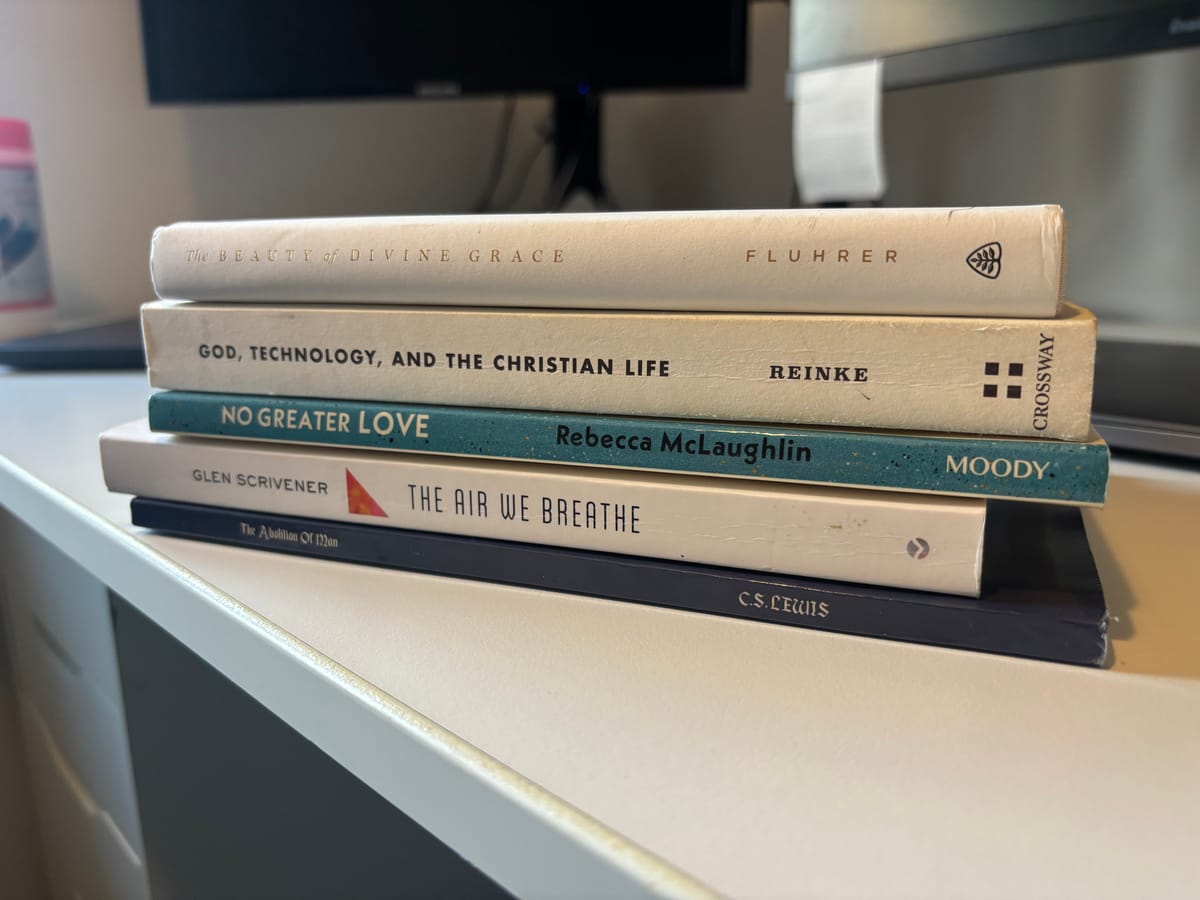
As 2025 comes to an end, I thought I would take the opportunity to reflect on the books I most enjoyed reading this year and those I would recommend to others. There was a lot to choose from, so I whittled the list down to just five books. Note: these only include paperback editions. I have nothing against Kindle or audiobooks. It just happens that these books were all paperbacks.
The truth is, I haven’t read nearly as much as I would have liked this year, as finding quiet time to read can be difficult while adjusting to family life with a toddler. So, in no particular order, here are my top five favourite books I read this year and would recommend to you.
The Beauty of Divine Grace by Gabriel Fluhrer
I was gifted this book by a friend in church and I very much enjoyed reading it. It covers the five solas of Christianity which state that salvation is through grace alone, by faith alone, in Christ alone, as revealed in Scripture alone, and for the glory of God alone. It clearly explains what makes Christianity uniquely different from every other religion.
Gabriel Fluhrer thoughtfully outlines why the Christian faith is not about humanity reaching up to God, but about God graciously reaching down to us in Christ. If you’ve ever found yourself questioning, or being questioned by others, about what sets Christianity apart, this book offers clear and reassuring answers. I found it easy to read yet rich in essential theological truth, making it both instructive and deeply comforting.
God, Technology, and the Christian Life by Tony Reinke
I wrote about this book in a separate blog post, so I'll recap what I wrote. Given that technology is now so woven into everyday life that it is almost inescapable. This book helpfully reminds us that technology is ultimately a gift from God to be used for His glory. It is a thoughtful and balanced book which reorients how Christians should think about technology by engaging both secular voices like Elon Musk and Yuval Noah Harari alongside theologians such as Calvin and Spurgeon, while grounding his arguments firmly in Scripture.
Tracing technology’s roots back to God’s creative purposes in Genesis, Reinke explores its rapid development, its benefits and limitations, and the ethical gaps that often lag behind innovation. The author challenges readers to see technology as a tool rather than a master, to be used under the Lordship of Christ. Ultimately, the book serves as a timely and necessary call for Christians to take technology seriously, using it wisely and faithfully in an age where its influence is impossible to ignore.
No Greater Love: A Biblical Vision for Friendship by Rebecca McLaughlin
I really enjoyed reading *No Greater Love: A Biblical Vision for Friendship* because it helped me think more deeply about how church fellowship can reflect Christ’s example of sacrificial love. Rebecca McLaughlin explores the highs and lows of friendship, showing that Christian friendship isn’t optional but a vital part of church life, rooted in Jesus’s command to love one another as He has loved us.
She doesn’t shy away from difficult topics like loneliness, hurt, or broken relationships, but always points us back to Christ’s love as the model and source of healthy friendships. The book challenged me to reflect on how I live out friendship in the church and encouraged me to pursue and offer love that builds up others in Christ.
The Air We Breathe by Glen Scrivener
This was a good one. It's a compelling and accessible book that shows how many of the Western values we often assume are secular (think freedom, kindness, progress, equality, compassion, consent, science and enlightenment) actually have their roots in the Christian faith and the teachings of Jesus, even in a culture that increasingly thinks it has walked away from Christianity.
Scrivener argues that these moral assumptions are like the “air we breathe” are so pervasive and taken-for-granted that we don’t notice them, yet they were born from the “Jesus revolution” and continue to shape our worldview even when their Christian origin is forgotten. This book was written with clarity and historical insight and invites both Christians and skeptics to see that what we value most in modern Western society is deeply shaped by the gospel, challenging us to recognise and cherish the enduring influence of Christian thought in an increasingly secular age.
The Abolition of Man by CS Lewis
I would recommend getting this book with a decent commentary, as it is a very heavy read by itself. Basically, The Abolition of Man is a profound short piece of work arguing that abandoning objective moral values in favour of subjective feelings and purely rational calculation ultimately undermines what it means to be human. In the final section he warns that if we reject these objective standards, we pave the way for “Conditioners” who, empowered by science and ideology, will shape humanity according to their own will, leading not to freedom but to the dehumanisation or “abolition” of man.
To keep it brief, this book is worth reading as it challenges us to recognise that rejecting objective moral values ultimately undermines what it means to be truly human and offers a powerful defence of universal truth and virtue.